Buying a Home in Utah County on One Income (2026)
Can I Buy a House in Utah County on a Single Income? What It Takes in Eagle Mountain and Saratoga Springs (2026)
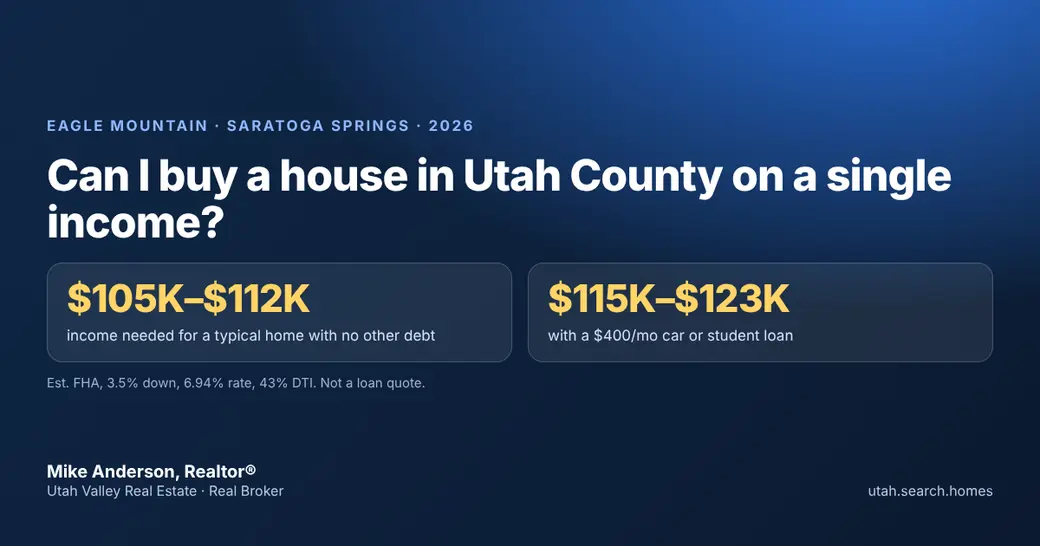
Short answer: Yes, but not at every price point, and not on every income. At today's rates, a typical Eagle Mountain or Saratoga Springs home (roughly $490,000 to $540,000) takes about $105,000 to $112,000 of income if you have no other debts, and closer to $115,000 to $123,000 if you carry a $400 monthly car or student loan payment. Below that income, buying is still realistic, but usually means a townhome or condo, a smaller budget, down payment help, or a co-buyer. The rest of this guide shows the math so you can find where you land.
The quick numbers
| What | Figure | Source |
|---|---|---|
| Median sale price, Eagle Mountain (July 2026) | $522,411, up 5.0% year over year; 32 days on market; 99.6% of list price | MLS data via BestUtahRealEstate |
| Median sale price, Saratoga Springs | $539,900 in July 2026; $490,000 in October 2026 (a thin month, 93 closings) | MLS data via BestUtahRealEstate |
| Median sale price, Utah (September 2026) | $530,000, up 1.9% year over year | Utah Association of Realtors |
| Utah County median household income | $96,877 (a household figure, and many households have two earners) | U.S. Census ACS |
| Income needed for Utah's median-priced home (10% down) | $147,000 in the first half of 2026 | Kem C. Gardner Policy Institute |
| 30-year fixed rate, week of November 12, 2026 | 7.11% | Freddie Mac |
Q&A: the questions buyers actually ask
Can I really buy a house in Utah County on one income?
Yes, if your income, debts and down payment line up with the price range you are shopping. Lenders do not require two incomes. They look at your credit score, your debt-to-income ratio (DTI), and cash for the down payment and closing costs. A single earner at about $110,000 with little other debt can qualify for a median-priced home in Eagle Mountain. A single earner at $75,000 will generally be shopping in the mid-$300,000s.
Context matters here. Utah County's $96,877 median household income is a household number, and in a county with a young, family-heavy population, many of those households have two earners. The Gardner Institute found that only 26.1% of Utah homes sold in 2025 were affordable to a household earning the area median income. Buying on one income is a narrower path than it was a few years ago, but it is not closed.
How much income do I need to buy in Eagle Mountain or Saratoga Springs?
Here is the monthly payment and the income needed at three price points. The estimates assume an FHA loan at 3.5% down and a 6.94% rate, plus property tax, homeowners insurance and FHA mortgage insurance. A lender will typically approve a total debt load up to about 43% of gross income, so this table works backward from that limit.
| Home price | Cash down (3.5%) | Est. monthly payment* | Income needed, no other debt | Income needed, with $400/mo other debt |
|---|---|---|---|---|
| $450,000 | $15,750 | $3,446 | about $96,000 | about $107,000 |
| $490,000 | $17,150 | $3,744 | about $104,000 | about $116,000 |
| $525,000 | $18,375 | $4,004 | about $112,000 | about $123,000 |
*Principal, interest, property tax (about 0.54% of price per year), homeowners insurance ($1,454 per year, the Utah average) and FHA mortgage insurance. Closing costs and any HOA dues are not included. These are planning estimates, not a loan quote.
Notice the Gardner Institute's $147,000 benchmark is higher than the table. The reason is the yardstick. Gardner's figure corresponds to a payment of about 30% of income, the conservative budgeting rule. Lenders will often approve a bigger share of your income than that. Whether you should spend 40%+ of gross income on housing is a budgeting decision, not just an approval decision.
What can I afford on $60,000, $75,000 or $85,000 a year?
This table reverses the question: given your income, what price range does the math support? Same assumptions as above (FHA, 3.5% down, 6.94% rate, 43% DTI).
| Your annual income | Max price, no other debt | Max price, with $400/mo other debt |
|---|---|---|
| $60,000 | about $275,000 | about $220,000 |
| $75,000 | about $345,000 | about $295,000 |
| $85,000 | about $395,000 | about $340,000 |
| $96,877 (Utah County median household) | about $455,000 | about $400,000 |
| $110,000 | about $515,000 | about $465,000 |
The takeaway: every $400 a month of other debt cuts your buying power by about $55,000. Paying off a car loan before applying can do more for your budget than almost any other single move.
What do homes actually cost in Eagle Mountain and Saratoga Springs right now?
Eagle Mountain's median sale price was $522,411 in July 2026, up 5.0% from a year earlier. Homes took a median of 32 days to go under contract and sold at 99.6% of their final list price, so there is little room to negotiate on well-priced homes. A summer 2026 market report put Eagle Mountain's single-family median at about $524,900 and described it as one of the more affordable ways into newer construction in the county.
Saratoga Springs is more volatile. Its median sale price was $539,900 in July, and then fell to $490,000 in October. Treat the October figure with care: only 93 homes closed that month, down from 122 in September, and a single month's median swings with the mix of homes that sold. In October, 64 of 93 closings landed between $400,000 and $700,000. In September, Saratoga Springs had 549 homes for sale, about 5.5 months of supply, which is more buyer-friendly than the past few years.
For a sense of the wider area, Utah County's median sale price was around $548,000 in mid-2026 and Provo was near $514,000.
How much down payment do I need, and is there help?
You do not need 20%. An FHA loan requires 3.5% down with a credit score of 580 or higher (10% down for scores between 500 and 579). Utah County's 2026 FHA limit for a one-unit home is $601,450 according to one local lender's summary, so most Eagle Mountain and Saratoga Springs homes fit under it.
Utah Housing Corporation (UHC) offers the main assistance programs:
- FirstHome loan: a below-market first mortgage for first-time buyers (no ownership in the prior three years). Credit score minimum is 660. Reported Utah County limits are $142,400 income for one or two people and a $763,100 purchase price.
- Down payment assistance second mortgages: up to 6% of the loan (or $27,500, whichever is less) with a monthly payment, or up to 3.5% deferred with no monthly payment but with simple interest accruing.
- First-Time Homebuyer Assistance Program: up to $20,000 at 0% interest with no monthly payment. The Legislature created it in 2023 with $50 million. Reported conditions include at least 12 months of Utah residency and new construction priced at $450,000 or less, and funds can go toward the down payment, closing costs or a permanent rate buydown. Funding is limited. Around 297 slots remained in May 2026.
Program limits change every year, so confirm current numbers with a UHC-participating lender before you plan around any of them. Using the table above, $27,500 of assistance would cover the entire 3.5% FHA down payment on a $490,000 home with money left toward closing costs.
Does my credit score matter on a single income?
More than it does for a two-income household, because you have less cushion. Typical minimums in Utah: 580 for FHA with 3.5% down, 620 for FHA or VA loans through UHC, 660 for FirstHome, and 680 for Freddie Mac's HFA Advantage conventional loan. A higher score does not only help you qualify. It also lowers your rate and mortgage insurance cost, which lowers the income you need.
What are property taxes in Eagle Mountain and Saratoga Springs?
Utah gives primary residences a 45% exemption, so you are taxed on 55% of market value. Eagle Mountain's own estimate for a $488,000 home is about $2,650 a year in total tax, with the school district taking about $1,585 of it. That works out to roughly 0.54% of home value.
Both cities raised their city rates for 2026, so check the current figures:
- Eagle Mountain: after a resident referendum filing, the council repealed a larger increase and adopted a rate of 0.000900, up from 0.000530. The city says that adds about $99 a year for a median-priced home, and the money funds a Utah County Sheriff's Office contract. It is the city's first increase since 2010.
- Saratoga Springs: the city proposed a 50.03% revenue increase, which its notice said would take the city portion on a $542,000 home from $291.54 to $437.31 (an extra $145.77 a year). It cited fire and police needs. Confirm the final adopted rate with the city or Utah County.
The city portion is the smaller slice of your bill. For a single earner, the point is that a tax increase of $100 to $150 a year moves your monthly payment by about $8 to $12, which matters far less than your interest rate.
How much is homeowners insurance?
Utah's average premium is about $1,454 a year (roughly $121 a month) according to MoneyGeek, and other surveys put it between about $940 and $1,660 depending on the method and coverage level. Utah is among the cheaper states, but your own quote depends on the home's age, coverage and your credit. Get quotes before you make an offer.
Is a townhome or condo the better single-income path?
Often yes. Attached homes generally price below the single-family median, which pulls the required income down along the lines of the tables above. The trade-off is HOA dues, which count against your DTI the same way a debt does and which vary widely by community. Ask for the HOA budget, reserve study and any planned special assessments before you write an offer, and ask your lender whether the building is approved for FHA financing.
Should I wait for rates to drop?
Nobody can reliably time this, so use math instead of a prediction. On a $490,000 home with 3.5% down, every half-point drop in rate lowers the payment by about $160 a month (from about $3,182 principal and interest at 6.94% to about $3,022 at 6.44%). If you buy now and rates fall later, you can refinance, though refinancing costs money and is never guaranteed. If you wait, you risk higher prices: Eagle Mountain's median rose 5.0% over the past year. The better question is whether you can comfortably afford the payment at today's rate. If you can only afford it at a lower rate, waiting or building a bigger down payment may be the safer call.
Does being single hurt my chances?
Not by itself. Lenders do not care about marital status. What they weigh is stable income (usually two years of work history), credit, debts and reserves. If your numbers are a little short, options include a co-borrower such as a family member or partner, gift funds from family toward the down payment (with documentation), or a lower price target.
A simple way to test your own numbers
- Take your gross annual income and divide by 12.
- Multiply by 0.43 and subtract your monthly debts (car, student loan, credit card minimums). That is the most a lender will likely let your housing payment be.
- Compare it to the monthly payments in the table above for the price you want.
- Then ask yourself whether you would be comfortable at that payment. Staying nearer to 30% to 35% of gross income gives you room for repairs and savings.
For example, at $96,877 a year, 43% works out to about $3,471 a month for all debts. That supports a payment near the $450,000 row only if you carry no other debt.
Bottom line
Buying on one income in northern Utah County is possible, but the math is tight at today's rates. The factors that move it most are your other monthly debts, the price tier you choose (including attached homes), your credit score, and whether you qualify for down payment or buydown help. Run the numbers for your own income before you tour, so you shop at a price you will be comfortable with.
Mike Anderson is a Utah real estate agent with Real Broker and has 25 years of real estate experience serving Northern Utah County. This article is general information, not financial or lending advice. Figures are estimates based on the sources below as of November 19, 2026. Confirm current rates, program limits and tax rates with a lender and the county before making decisions.
Sources
- Eagle Mountain market data (July 2026): bestutahrealestate.com/utah/eagle-mountain
- Saratoga Springs market data (Sept and Oct 2026): bestutahrealestate.com/utah/saratoga-springs/market-stats
- Utah median price, Sept 2026 (Utah Association of Realtors): bestutahrealestate.com/utah/market-stats
- Utah County summer 2026 market update: utlocal.com/utah-county-summer-2026-housing-market-update
- Kem C. Gardner Policy Institute, State of the State's Housing Market 2025-2026 (via attheu.utah.edu and Deseret News, Sept 9, 2026)
- Utah County median household income (Census ACS): statedemographics.com/utah/utah-county
- Freddie Mac weekly rate, Nov 12, 2026, and FHA rates (themortgagereports.com, Nov 9, 2026)
- Utah Housing Corporation programs: utahhousingcorp.org; SuperMoney, Down Payment Assistance in Utah (2026); Herald Extra, April 28, 2026
- FHA loan limits 2026 (Integrity First Lending; Herring Bank)
- Eagle Mountain property tax: eaglemountain.gov/your-property-taxes-explained; Daily Herald, Aug 20, 2026
- Saratoga Springs proposed tax increase: utah.gov Public Notice Website, notice for Aug 11, 2026 hearing
- Utah homeowners insurance averages: MoneyGeek, ValuePenguin, NerdWallet (2026)
Categories
- All Blogs (65)
- Alpine, Utah (4)
- Cedar Hills, Utah (4)
- Eagle Mountain, UT (19)
- Lehi Utah (7)
- Lindon, Utah (4)
- Mortgage Lending (4)
- Open House (1)
- Orem, Utah (9)
- Pleasant Grove, Utah (4)
- Provo, UT (5)
- Salem, Utah (2)
- Saratoga Springs, UT (13)
- Springville, Utah (2)
- Traverse Mountain (4)
- Utah Valley Real Estate (38)
- Vineyard, Utah (5)
Recent Posts




GET MORE INFORMATION